Mission & History
Vision Statement:
Temple Emanuel is an inclusive and progressive Reform Jewish community. Our vision is to be a spiritual home rooted in God, Torah, and Israel; where tradition meets innovation, and where everyone can find their unique path to Jewish engagement.
Mission:
- Cultivate innovative and participatory approaches to worship, spirituality, ritual, and practice that resonate with our diverse congregation.
- Provide exceptional educational experiences for all ages.
- Champion and pursue social justice and social action as ethical and moral imperatives in pursuit of tikkun olam, repairing our broken world.
- Strengthen connections to the Jewish people worldwide and advocate for the State of Israel as a just and secure homeland for the Jewish people and all its inhabitants.
- Foster open dialogue and understanding on complex issues, including Israel and current events, while respecting diverse viewpoints within our community.
- Enrich our worship and community through music and the arts.
- Warmly welcome and fully integrate interfaith families and non-Jewish members, celebrating the rich tapestry of our congregation.
- Nurture a culture of philanthropy to ensure our temple’s financial stability and growth.
- Develop strong leadership and plan to secure our temple’s future.
- Grow our membership while maintaining our down-to-earth, heimish (warm and informal), atmosphere.
- Build bridges between Jewish and non-Jewish communities in our area, promoting understanding and cooperation.
Through these endeavors, we strive to create a vibrant, sustainable, and inclusive Jewish community that enriches the lives of our members and positively impacts our broader society.
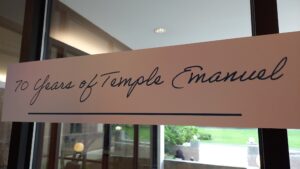
See the Timeline: 70 Years of Temple Emanuel
– With thanks to Sandra Fleishman, David Fishback, Rabbi Adam, Phil Magenheim, and the 70th Anniversary Committee.
Honoring Our Cantors
Digital gallery created in 2024 with videos and recordings of Temple Emanuel’s Cantors

March 2024
Temple Emanuel Policy Concerning Candidate Endorsements and Political Speech and Activities
November 2025
Context & Legal Background
Temple Emanuel is a tax-exempt organization under Section 501(c)(3) of the Internal Revenue Code, which severely limits the participation of tax-exempt organizations—including synagogues—in political campaigns. The statute has historically been applied to prohibit Section 501(c)(3) organizations from endorsing or opposing candidates, and Temple Emanuel has consistently abided by this prohibition.
On July 7, 2025, the IRS entered into a proposed consent judgment in a case involving the National Religious Broadcasters and two Texas churches which in essence provides, that if approved, the IRS will not enforce the prohibition against endorsing or opposing candidates in connection with “bona fide communications internal to a house of worship… in connection with religious services through its customary channels” when addressing electoral politics through a lens of religious faith.
While the IRS rarely enforced the prohibition in the past, it has neither been repealed nor amended. Still, the IRS’ new position changes the landscape. In light of the IRS’ new interpretation and to avoid any confusion, Temple Emanuel is adopting this Policy Concerning Candidate Endorsements and Political Speech and Activities.
Scope & Purpose
This policy governs political speech by Clergy, staff, and lay leaders in religious services or through customary communication channels and use of Temple grounds, facilities, and resources. It aims to:
– Preserve the organization’s 501(c)(3) tax-exempt status.
– Uphold sermon integrity and congregational trust.
– Respond prudently to the IRS’s updated interpretation.
Definitions
- Campaign event: A planned gathering, appearance, or activity organized for the purpose of promoting, supporting, or advancing a particular candidate.
- Current campaign issues: The political, social, or economic topics that are most important and debated during the present election, shaping candidate’s messages and voters’ decisions.
- Customary communication channels: Including, but not limited to: sermons, internal newsletters (e.g., Grapevine and Kol Kore), in-service announcements, Temple endorsed Social Media sites, Temple website, Temple group listservs, Religious School and Early Childhood Center communications, and comments made by Temple teachers in classrooms.
- Election Season: The period beginning on the date a candidate registers to run in a primary or general election for an office and ending with the date of the corresponding primary or general election for that office.
- Express personal opinion (personal capacity): Statements outside religious services and customary communication channels, clearly labeled as personal.
- Lay Leaders: Members of the Temple Board of Trustees.
- Political endorsement: Explicit candidate recommendation or opposition intended to influence voting.
- Religious services: Formal worship gatherings.
- Temple Event: An event/activity sponsored and advertised by the Temple.
Permissible Conduct
Clergy, staff, and lay leaders may, in good faith, engage in communications related to political issues as opposed to specific candidates, including during religious services and through customary communication channels. This includes the ability to advocate for or against issues, legislation and policy positions, for example including ballot initiatives. However, clergy, staff and lay leaders need to maintain an awareness that even their personal words and actions may reflect on the congregation.
Clergy, staff, and lay leaders may endorse or oppose; solicit donations; and engage in get out the vote efforts; for specific candidates, so long as it is clear from the context of such activities that they are undertaken in their personal capacity, and not in their Temple Emanuel role. In some circumstances, a specific disclaimer may be helpful to make clear that the activity has been undertaken in a personal, and not official capacity.
Voter registration drives or get-out-the-vote efforts that do not endorse or oppose a specific candidate or party may be hosted on Temple property or at Temple events only with the express prior approval of the Executive Director to assure compliance with this Policy.
Prohibited Conduct
Clergy, staff, or lay leaders may not, in their Temple Emanuel role, endorse or oppose candidates for public office.
During election season, candidate appearances as campaign events may not be hosted on Temple property or at a Temple event.
Clergy, staff or lay leaders may not, in their Temple Emanuel role, solicit donations for or on behalf of a candidate, even if not on Temple property or during a Temple event.
Voter registration drives or get-out-the-vote efforts with the express purpose of electing or opposing a specific candidate or party may not be hosted:
-by Clergy, staff or lay leaders in their Temple role,
-on Temple property, or
-at Temple events.
During an Election Season, a registered candidate may not be invited to speak at a Temple event on current campaign issues without providing a comparable opportunity to opposing registered candidates.
No Temple resources may be used by Clergy, staff, or any Temple member for personal political advocacy, endorsement or opposition, including for example, advertisement for in-home candidate meet and greets or fundraising.
Review & Amendment
This policy should be reassessed regularly, particularly if court interpretations or IRS guidance changes.
Temple Emanuel Policy on Diversity, Equity, and Inclusion
March 2022
Temple Emanuel is committed to a diverse, equitable, and inclusive environment where all congregants, staff, board of trustees members, committees, volunteers, and guests feel welcome, accepted, respected, and valued, and to a nondiscriminatory approach that provides equal opportunity for employment and participation in all of its activities.
Temple Emanuel embraces, encourages, and is committed to advancing its community’s diversity in age, race, ethnicity, family or marital status, sexual orientation, gender identity or expression, language, national origin, physical and cognitive ability, mental health status, political affiliation, religion, socio-economic status, veteran status, and other characteristics.
Temple Emanuel values diversity, equity, and inclusion, and is actively committed to taking steps that will advance those principles in every aspect of our congregation.
Temple Emanuel’s diversity, equity, and inclusion initiatives are applicable, but not limited, to all of our practices and policies on membership, religious practices and rituals, employment, education, and other Temple operations.
All members and staff of the Temple Emanuel Community have a responsibility to treat others with dignity and respect at all times, and their conduct must be equitable and inclusive with regard to all activities.
Temple Emanuel is committed to modeling diversity, equity, and inclusion for the entire reform Jewish community and maintaining fair and equal treatment for all.
History
Temple Emanuel is the oldest Reform Congregation in Montgomery County, Maryland. Formally organized with 28 member families in August 1952, we affiliated with the Union of American Hebrew Congregations (now Union for Reform Judaism) in March 1953.
Temple Emanuel engaged Rabbi Leon Adler as our first full-time rabbi in July 1953, and he continued to serve the congregation until his death 35 years later. In 1988, Temple Emanuel welcomed our second spiritual leader, Rabbi Warren Stone, who stayed with us until his retirement in 2020. Rabbi Adam Rosenwasser joined Temple Emanuel as Senior Rabbi on July 1st, 2020, bringing with him a passion for creating meaningful Jewish experiences for people of all ages and backgrounds.
Temple Emanuel has three Memorial Scrolls – learn more about them here.
In worship, we use the Reform prayer book Mishkan T’filah, which gives new spiritual content to our services. Every Shabbat morning, there is lay-led Torah and Tanach study followed by a Minyan.
The Temple offers opportunities to share both joys and sorrows. We celebrate together baby namings, consecrations, B’nai Mitzvah, confirmations, weddings, and other life affirming events. We also join in consoling one another in times of illness and mourning.
The congregation is in many respects a partnership between its members and its professional staff. Neither could function without the other. Volunteers serve on Temple committees dealing with the range of Temple activities: fund raising, publicity, the Religious School, the Early Childhood Center, buildings and grounds, religious services, adult education, social action, the Green Team, and others, as well as Women of Reform Judaism and the Temple Brotherhood. Our teenage members have access to their own youth lounge, and they participate in KESTY, our youth group. Whatever talents or interests you bring with you, there is a place for you in the Temple family.